“It’s all about creation and surprise. It just needs to be appreciated and watered like flowers.
You have to water flowers. These peaks will come again.”
– Sonny Rollins
The legendary tenor saxophonist, Walter Theodore “Sonny” Rollins died on May 25, 2026 at the age of 95.
Yesterday, May 26 marked the Centennial of Miles Dewey Davis III, American trumpeter, bandleader and composer.
It seems fitting to take some Blue Mind time for “The Blues” on Day 2 of 100 Days of Blue.
From Wikipedia: Blues is a music genre and musical form that originated among African Americans in the Deep South of the United States around the 1860s. Blues has incorporated spirituals, work songs, field hollers, shouts, chants, and rhymed simple narrative ballads from the African-American culture. The blues form is ubiquitous in jazz, rhythm and blues, and rock and roll, and is characterized by the call-and-response pattern, the blues scale, and specific chord progressions, of which the twelve-bar blues is the most common. Blue notes (or “worried notes”), usually thirds, fifths or sevenths flattened in pitch, are also an essential part of the sound. Blues shuffles or walking bass reinforce the trance-like rhythm and form a repetitive effect known as the groove.
One can write or talk about the factual definition of the Blues, but the Blues is about a feeling… and we all know THAT feeling.
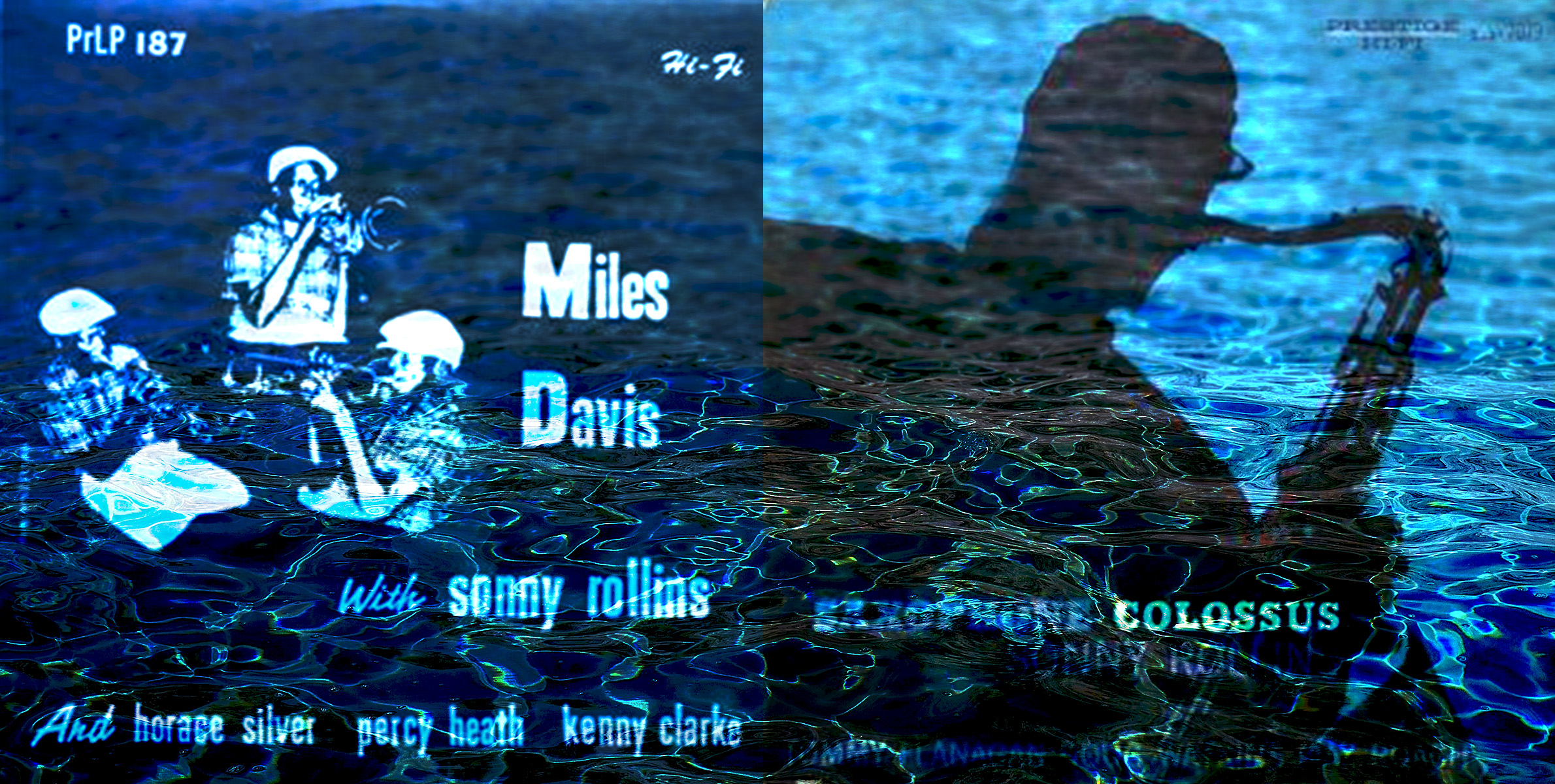
Miles Davis, Bluing, featuring Sonny Rollins from the 1953 album, Blue Period.
Miles Davis (trumpet), Jackie McLean (alto saxophone), Sonny Rollins (tenor saxophone),
Walter Bishop, Jr. (piano), Tommy Potter (double bass), Art Blakey (drums)
Sonny Rollins “Blue 7,” from Saxophone Colossus (1957), featuring Sonny Rollins (tenor saxophone), Tommy Flanagan (piano), Doug Watkins (bass), Max Roach (drums). Check out the ups and downs of “Blue 7” with the Jazzomat Research Project, hosted at the Hochschule für Musik Franz Liszt Weimar (University of Music Franz Liszt Weimar).
In 1959, feeling pressured by the unexpected swiftness of his rise to fame, Rollins took a three-year hiatus to focus on perfecting his craft. A resident of the Lower East Side of Manhattan with no private space to practice, he took his saxophone up to the Williamsburg Bridge to practice alone: “I would be up there 15 or 16 hours at a time, spring, summer, fall and winter.”
He would disappear from performing in public, instead choosing to play his saxophone in solitude – by himself, for himself.
“I found it’s a superb place to practice. Night or day.
You’re up over the whole world. You can look down on the whole scene. There is the skyline, the water, the harbor. It’s a beautiful scene, a panoramic scene…You can blow as loud as you want. It makes you think. The grandeur gives you perspective.”
– Sonny Rollins on playing on Williamsburg Bridge
BBC 2: “Who is Sonny Rollins” (1963) Imago records & production, License: Attribution Non-Commercial Share Alike.
With Rollins death, there is a renewed push by the Sonny Rollins Bridge Project to rename the Williamsburg Bridge.
We, the undersigned, support renaming the Williamsburg Bridge as the Sonny Rollins Williamsburg Bridge in honor of an outstanding New Yorker, the jazz legend Sonny Rollins, who practiced daily on the Williamsburg Bridge from the spring of 1960 to the fall of 1961. At that time, Mr. Rollins was living at 400 Grand Street on Manhattan’s Lower East Side, and through reflection and discipline, adjusted his path and purpose, becoming a model of self-determination and resilience for all New Yorkers.
Sign the Change.org Petition
https://www.change.org/p/rename-the-williamsburg-bridge-as-the-sonny-rollins-bridge
Imagine a giant wave of “Bluing” over the country – from coast to coast, bridge to bridge.
If the Sonny’s Bridge were to renamed, it would be A Great Day indeed!
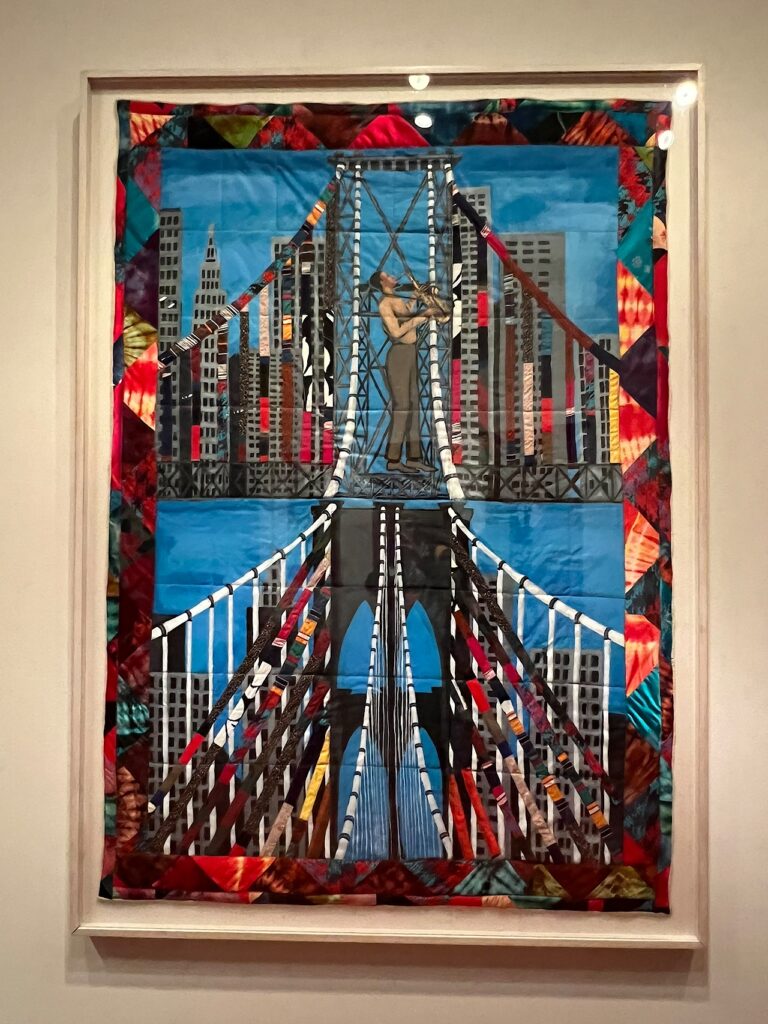
Faith Ringgold, Sonny’s Bridge, 1986, Acrylic on canvas with printed and pieced fabric, 84 ½ × 60 in (214.6 × 152.4 cm)
San Francisco Poet Laureate Genny Lim reads her poem, “The Bridge For Sonny Rollins (Sept. 7, 1930 )” Inspired by Faith Ringgold’s art quilt, with musical accompaniment by Destiny Muhammad. The Last Hoisan Poets “American People: A Celebration of Faith Ringgold” on November 19, 2022 at the de Young Museum in San Francisco